360 virtual tour for a new development: selling apartments that do not exist yet
How a 360 virtual tour lets off-plan buyers walk an unbuilt apartment, paired with live availability, built from the renders an Estonian developer already owns.
You are selling apartments that do not exist yet. The building is a render, the home is a floor plan, and the buyer is asked to commit before a single wall is poured. That gap is where deals stall. A 360 virtual tour for real estate closes it: the buyer steps inside the future apartment, looks around, and stops imagining. In this article you'll learn why a 360 tour for a new development changes off-plan apartment sales, how it pairs with live availability, how it's built from renders you already own, and where a physical show flat fits (and where it no longer does).
Key Takeaways
- A 360 virtual tour lets an off-plan buyer walk through a future apartment before construction, turning an abstract plan into a space they can picture living in.
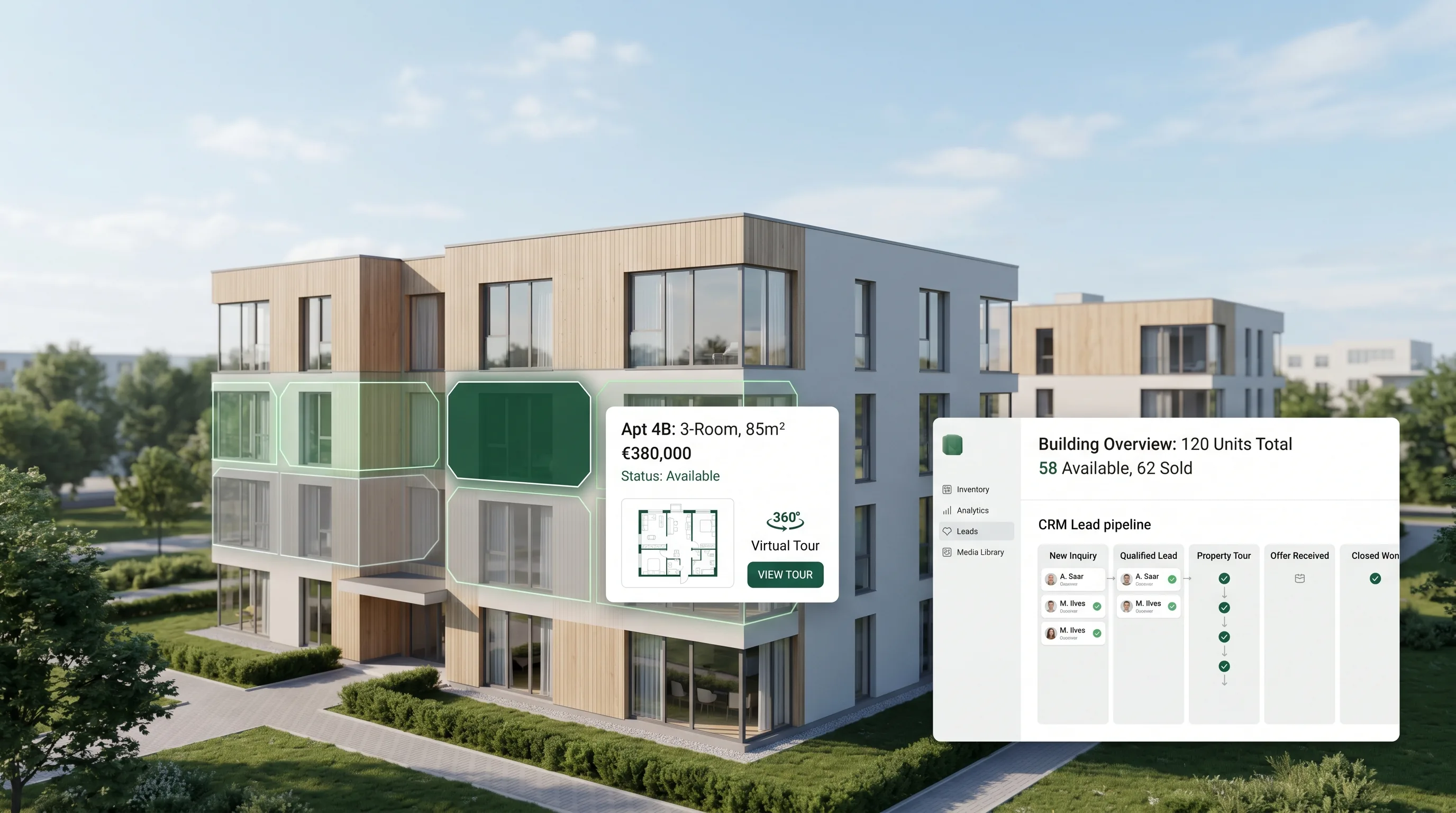
- Paired with a clickable facade showing live status (free, booked, sold), floor, m2 and plan, the tour answers "what's it like" and "is it still available" in one surface.
- A new build has to work harder to be understood and chosen, because the buyer is committing to something that does not physically exist yet.
- The tour is built from the renders you already commissioned, so they become an always-on sales surface instead of files that sit idle after delivery.
Why does an off-plan buyer need a 360 virtual tour?
A 360 virtual tour lets an off-plan buyer move through a future apartment, ceiling height, window light, room flow, well before construction starts. A buyer weighing a bigger commitment wants to feel sure, and there is nothing physical yet to reassure them. The tour replaces guesswork with a felt experience.
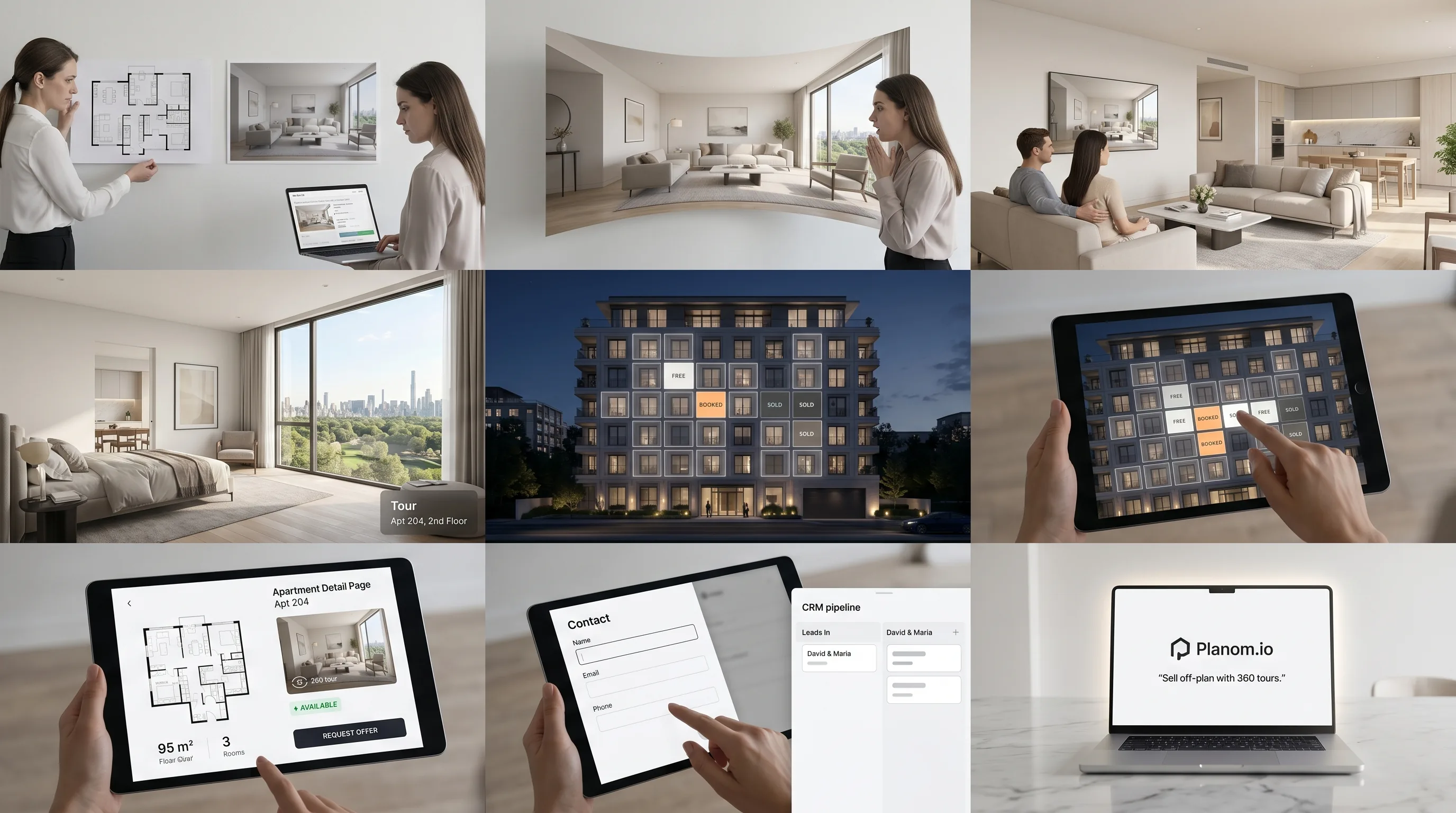
Think about what an off-plan buyer actually has to do. They look at a render, read a floor plan, and decide on a home they have never stood in. That is a real leap. A flat image shows you a room; a 360 tour puts you in it. You turn, you look up, you sense the proportions. The abstraction collapses into something a person can actually judge.
This matters more in a new development than anywhere else, because there is nothing physical to visit. In existing-stock sales the buyer walks the actual flat. Off-plan, the tour is the viewing. The Estonian term is virtuaaltuur; in Russian, виртуальный тур (virtualnyy tur) or 3D тур. The same idea in three languages: let the buyer arrive before the building does.
In our experience, the moment a buyer can look out the actual window orientation of their future flat, the conversation shifts from "what does it look like" to "where would the sofa go". That is a buyer who has already moved in, in their head.
What is a 360 tour for a new development, exactly?
A 360 tour for a new development is a set of walkable interior panoramas, one per apartment type, that a buyer navigates by dragging to look around and clicking to move between rooms. It is built from the same interior renders a developer commissions, then stitched into spherical views. In our experience these tours have moved from a nice extra to something off-plan buyers now expect to find.
The key word is walkable. A still render is a destination you arrive at. A 360 tour is a space you explore, on your own terms, at your own pace. You decide where to look. That sense of agency is what makes it land differently from a brochure image.
For a new development, one tour per apartment type usually covers the inventory, since most homes share a handful of layouts. A two-bedroom type, a corner type, a studio: each gets a tour, and every matching unit points to it. That keeps production sane while every buyer still gets a relevant walkthrough.
The tour rarely stands alone. It often pairs with guided assistance and configurable finishes, so a buyer can swap a kitchen palette or a flooring option and watch it change. That turns one render package into several presentable versions of the same home.
How does a 360 tour pair with live availability?
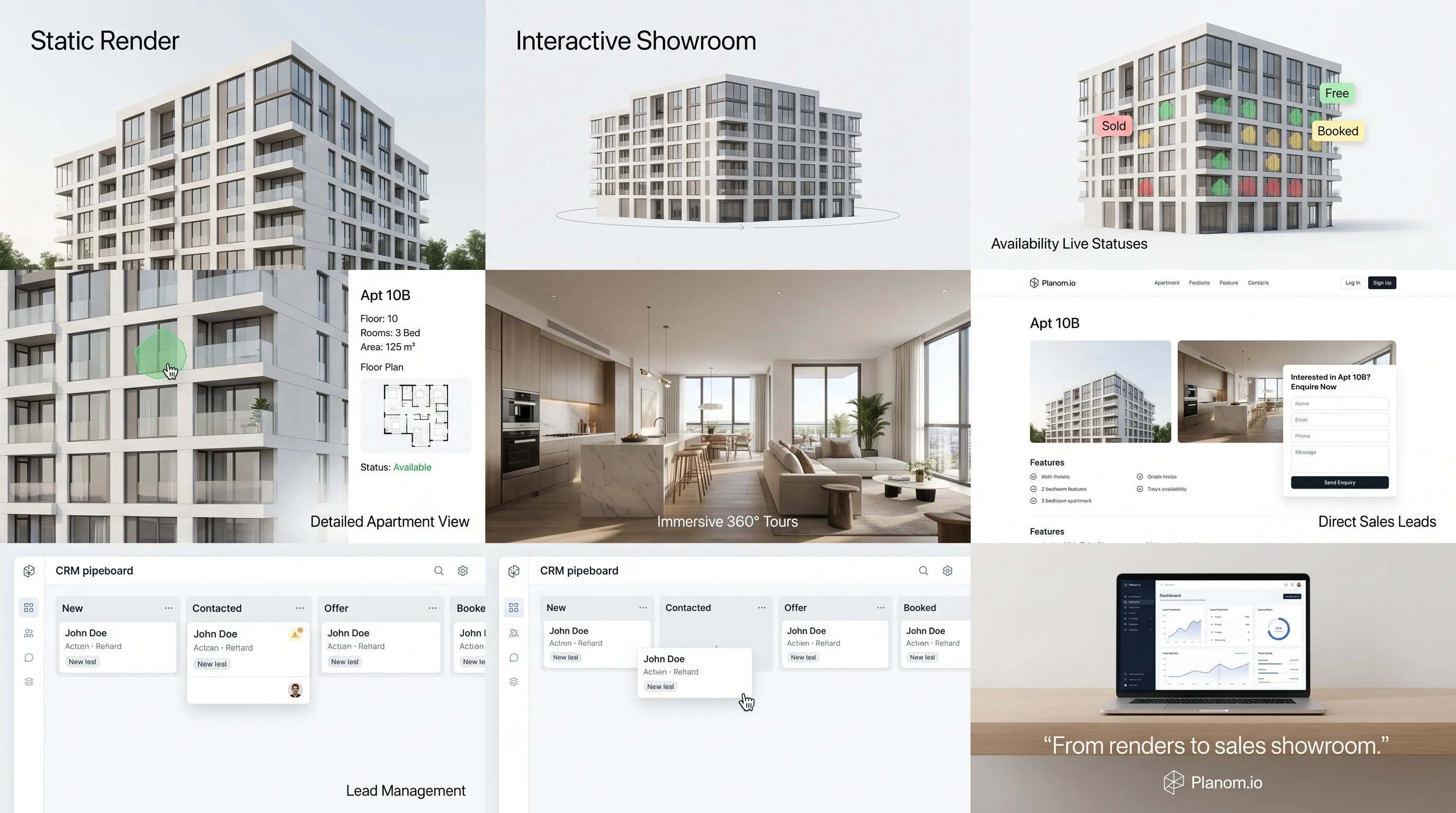
A 360 tour answers "what is this home like"; live availability answers "can I still have it". Pairing them on one surface is what converts. In our experience, a beautiful tour with no status field just creates frustrated buyers who fall for a flat that booked last week. The pairing comes from a clickable facade, where each apartment is a polygon showing status, floor, m2 and plan.
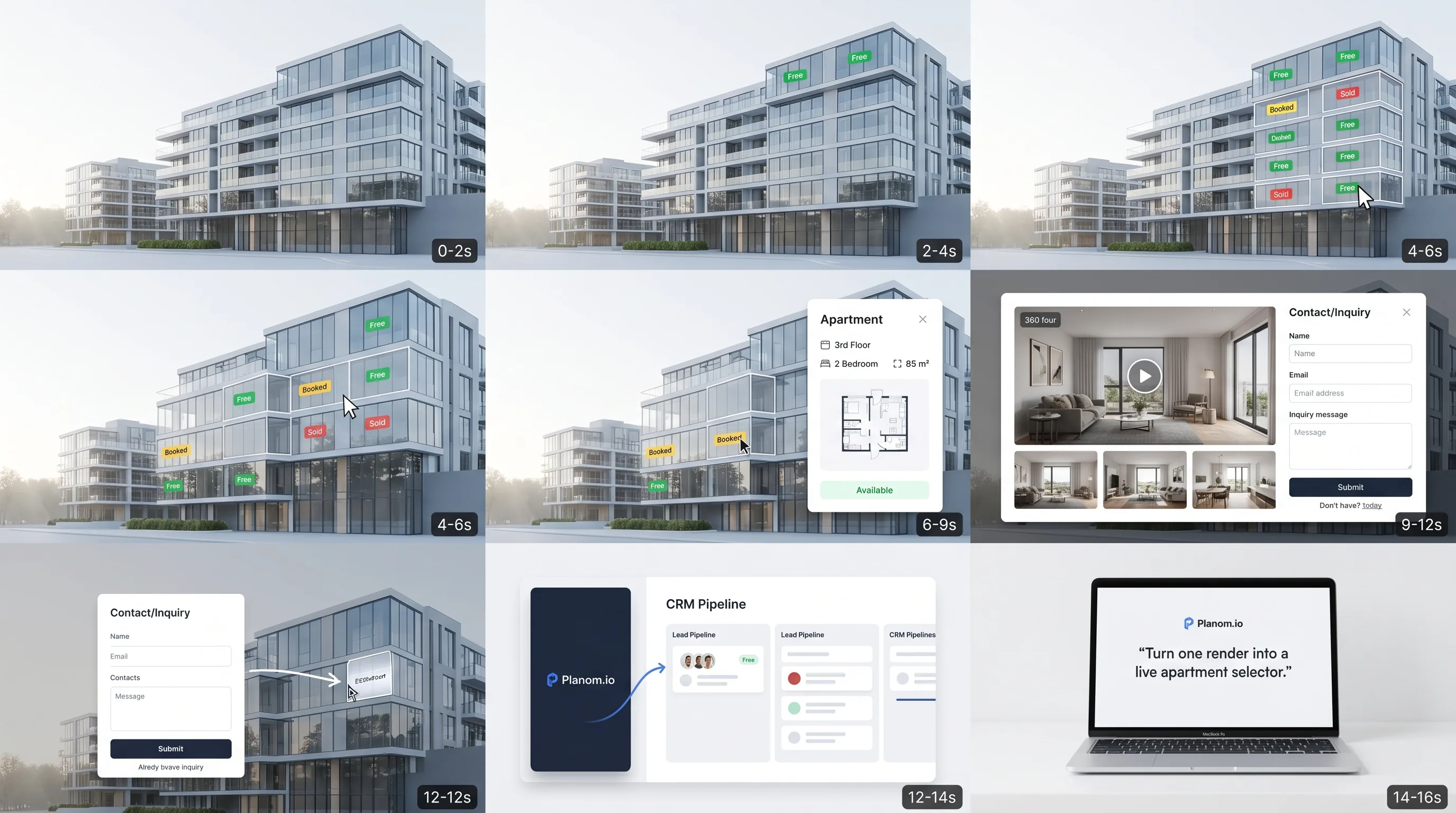
Picture the flow that works. A buyer orbits the building, sees which units are still free, and clicks one. That opens the apartment's page: its floor, layout, m2, room count, a contact form, and the 360 hero tour of its type. The buyer walks the space, confirms it is available, and reaches out, all without a phone call. No dead ends.
So why do the two questions need to sit together? Because the buyer's biggest doubts arrive at the same moment. Is it nice? Is it free? Split those across a brochure and a spreadsheet, and you lose momentum between them. Hold them on one screen, and the buyer never has to leave to find out.
Notice what the apartment surface deliberately shows: availability, status, floor plan, floor, m2, rooms and a contact form. The tour makes the home feel real; the status makes it feel reachable. Together they remove the two friction points that stall off-plan apartment sales.
A 360 tour and the physical show apartment
A 360 tour does not erase the physical show apartment, but it collapses the need for one early in the sales cycle. A 360 virtual tour for real estate lets a developer market and sell off-plan apartments from day one, long before a show flat could be built or furnished. That early window is exactly where an immersive tour earns its place.
Building a show apartment is slow. It needs the building to exist, the unit to be finished, and the furniture to arrive. By then, you have already wanted to sell for months. A 360 tour fills that whole window: it is the show flat you can publish before the foundation is even dug.
Does the physical flat still have a role? Sometimes, later, for buyers who want to confirm a feeling before signing. But the heavy lifting, the discovery, the shortlisting, the falling-in-love, happens online now. The tour does the early convincing; the physical visit, if it happens, simply seals it.
In our experience, developers who lead with the tour stop hearing "can I see it" and start hearing "is unit 4B still free". That is the question you want, because it means the home has already done its job.
Building a 360 tour from renders you already own
A 360 tour is built from the visualisations you already commissioned. The same interior renders that go into a brochure become the panoramas; the same exterior render becomes the orbit and the clickable-facade base image. A standalone visualisation studio typically delivers those files and stops there. The structural difference is what happens next: the assets stay live instead of going dormant.
Think about where most renders end up. They run once in a brochure or a portal listing, then sit quietly in a folder. The work is delivered, the assets are static, and the buyer relationship lives on someone else's platform. That is a lot of value left on the table.
The alternative is to treat those renders as raw material for an always-on sales surface. The exterior view becomes a 360 orbit. Each interior render seeds a walkable panorama. A flythrough animation becomes the transition between facade states. Nothing is re-shot; the existing work just keeps earning its keep.
Then there is reach. Estonian buyers search in Estonian, Russian and English, often through neutral listing portals, so a developer's own apartment pages should be discoverable in all three. A 360 tour wrapped in an indexable, per-apartment page gives Google something to surface, instead of one templated listing in a feed you do not control.
What does a connected off-plan sales surface look like?
It looks like one experience instead of a stack of tools. The buyer gets the orbit, the clickable facade, the 360 tour and the apartment page; the developer gets the lead, the notification, the pipeline and the analytics behind it. In our experience, developers increasingly want this single connected surface rather than five disconnected systems they have to reconcile by hand.
So why does fragmentation hurt the sale? Because every seam leaks. Visuals live in one tool, the lead form in another, the pipeline in a third. The buyer's interest cools in the gaps, and the developer pieces the story together manually. A connected surface keeps the journey, and the data, in one place.
Picture the end-to-end shape. A contact form on the apartment page becomes a lead. The firm gets an email notification. The lead moves through a pipeline: new, contacted, offer, booked. A shareable offer page goes to the buyer, and sales analytics show which units draw the most attention. An embeddable widget drops the whole tour onto the developer's own website, where an apartment click opens that apartment's page.
That is the difference between a tour as a destination and a tour as a sales surface. One impresses and ends. The other converts and keeps converting.
Frequently asked questions
Can you sell off-plan apartments with a virtual tour in Estonia?
Yes. Estonian new developments (uusarendus) are routinely marketed before completion from renders, plans and increasingly 360 tours, with availability tracked per unit. A virtual tour lets a buyer walk a future apartment and reach a decision well ahead of construction, which is exactly where off-plan apartment sales need the most help.
What is the difference between a 360 tour and a render?
A render is one flat image you look at; a 360 virtual tour is a walkable space you explore by dragging to look around and clicking to move between rooms. The render is a destination, the tour is an experience. Both come from the same visualisation work, but the tour gives the buyer agency and a real sense of the space.
How many 360 tours does a new development need?
Usually one walkable tour per apartment type, not per individual unit. Most new developments repeat a handful of layouts, so a studio, a two-bedroom and a corner type might cover the whole building. Every matching apartment then points to its type's tour, which keeps production manageable while each buyer still sees a relevant walkthrough.
Does a 360 tour mean I don't need a show apartment?
Largely, early on. A 360 tour for a new development fills the long window before a physical show flat could exist, letting you market and shortlist buyers from day one. A physical visit may still help close certain buyers later, but the tour does the discovery and the early convincing while the building is still a render.
What does a buyer see when they click an apartment?
The apartment's page: its floor, layout plan, m2, room count, live status (free, booked or sold) and a contact form, plus the 360 hero tour of its type. The page is shareable and indexable, so it can rank in search and be sent directly to a buyer, working as a real address rather than a slide in a deck.
Selling off-plan means asking buyers to trust a render. A 360 tour, paired with live availability, lets them trust their own eyes instead. If you have renders sitting idle after delivery, tell us about your project and we'll show you what they could be doing.
See your project as a live map.
Send us your drawings. We render it - and make it sell.